

QFZ External Audit Process: Step-by-Step Guide + Documents Checklist
Running a business in a Qatar Free Zone comes with real perks. You get full foreign ownership, tax incentives and a strong base for trade across the Gulf.…

Running a company in a Qatar Free Zone comes with real perks: full foreign ownership, tax benefits and world-class facilities. But it also comes with rules. One of the most important is the yearly audit, and only a QFZ approved auditor can sign off on it.
Pick the wrong firm and you could face late filings, rejected reports or penalties that put your licence at risk. Pick the right one and your audit becomes a smooth, predictable task each year.
So how do you tell the good firms from the rest? In this guide, we walk you through seven simple checks. Use them to compare audit firms in Qatar and hire with confidence.
A QFZ approved auditor is a licensed audit firm or professional that can audit companies set up under the Qatar Free Zones Authority (QFZA). In simple terms, it is an auditor whose report the Authority and Qatar’s tax system will accept.
Qatar currently has two free zones, both run by the QFZA:
Companies in both zones follow the QFZA Companies Regulations. Part 7 of these rules covers accounting and auditing, including the appointment of an auditor (Article 47) and the audit itself (Article 48).
In practice, a good QFZ auditor in Qatar should be registered as a practising auditor in Qatar and know the free zone rules well. For tax filings, Qatar’s Income Tax Law also expects the audit opinion to be signed by an auditor registered with the Ministry of Commerce and Industry (MOCI).
The audit is not optional. Under the QFZA rules, shareholders must appoint one or more auditors at their first General Assembly Meeting after incorporation. If they fail to do so, the managers must make the appointment.
Beyond legal duty, a clean audit report helps your business in several ways:
Also keep in mind that copies of your financial statements must be kept at your registered office for 10 years. So the quality of your audit file matters long after the report is signed.
Not all audit firms in Qatar are the same. Some are large global networks, while others are small local practices. Use the checklist below to compare them fairly.
| # | What to check | Why it matters | How to verify |
| 1 | Licence and QFZA acceptance | Only an accepted auditor’s report counts | Ask for MOCI registration; confirm with QFZA |
| 2 | Free zone experience | Fewer errors and faster sign-off | Ask for QFZ client examples |
| 3 | Industry knowledge | Better risk focus for your sector | Ask about similar clients |
| 4 | IFRS and tax expertise | Statements must meet IFRS and tax rules | Ask who reviews IFRS and tax points |
| 5 | Clear, fixed fees | No surprise bills | Get a written fee proposal |
| 6 | Realistic timeline | You meet every deadline | Ask for a dated audit plan |
| 7 | Independence and support | A fair opinion and year-round help | Check other services they provide you |
Start with the basics. Ask the firm for its Qatar auditor registration and the name of the partner who will sign your report. Then check with the QFZA, or your relationship manager there, that the Authority accepts this auditor for free zone entities.
Many business owners search for an “approved auditors list Qatar” online. Lists on third-party websites can be outdated, so always confirm directly with the Authority.
Free zone companies have their own rules on records, share capital, branches and change of control. QFZ auditors in Qatar who already serve free zone clients know these rules well. As a result, they ask the right questions early and avoid last-minute surprises.
Ask a simple question: “How many free zone companies do you audit each year?” A confident, specific answer is a good sign.
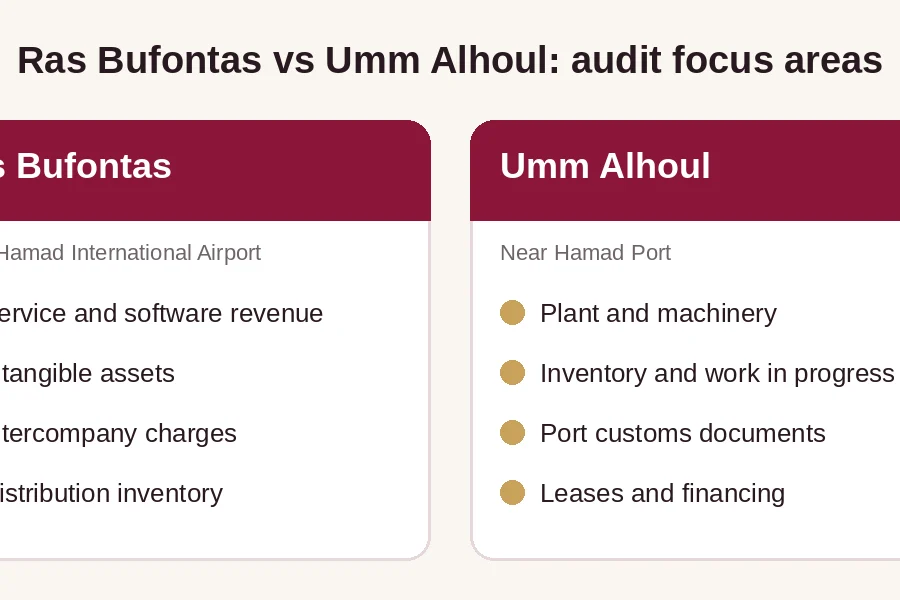
A logistics firm at Umm Alhoul faces different risks than a tech start-up at Ras Bufontas. For example, inventory counts matter a lot for a trader, while revenue recognition matters more for a software company.
Therefore, choose a team that has audited businesses like yours. They will focus on the areas that really carry risk.
Companies in Qatar prepare financial statements under International Financial Reporting Standards (IFRS). Moreover, your audited accounts often support your tax return.
So your auditor should understand both IFRS and local tax rules. Ask who on the team handles technical accounting questions and who reviews tax-related disclosures.
The cheapest quote is not always the best deal. However, the most expensive one is not always the best quality either. Look for a written proposal that clearly lists:
Comparing these details side by side is the easiest way to find the best audit firm in Doha for your budget.
Delays can affect your licence renewal and tax filing. A reliable auditor will share a dated plan that shows when fieldwork starts, when the draft report is ready and when the final report is signed.
Ask how they handle peak season. If a firm takes on too many clients in the first quarter, your audit may wait in a queue.
Your auditor must be independent. In other words, the same team should not prepare your accounts and then audit them. Many firms solve this by keeping bookkeeping and audit teams separate.
At the same time, good licensed auditors in Qatar free zone settings offer useful advice. For instance, they share a management letter with clear tips to improve your controls for next year.
Even careful business owners make these errors. Fortunately, each one is easy to avoid.
At Bookkeeping Qatar, we help free zone businesses get audit-ready and stay that way. Our team keeps your books clean all year, so your audit runs on time and without stress.
Here is how we support you:
Because our bookkeeping and audit work are handled by separate, independent teams, your audit stays fair and credible.
Choosing a QFZ approved auditor is one of the most important compliance decisions you make each year. Check the licence, confirm QFZA acceptance, and look for free zone and industry experience. Then compare fees, timelines and independence before you sign.
When you follow these seven checks, your audit becomes a simple, routine task rather than a yearly worry.
Need help finding the right auditor or getting your books ready for audit? Bookkeeping Qatar is here to help. Our experts support free zone companies in Ras Bufontas and Umm Alhoul with bookkeeping, year-end reporting and smooth auditor coordination.
Contact Bookkeeping Qatar today for a free consultation and make this year’s audit your easiest yet.
Yes. Under the QFZA Companies Regulations, shareholders must appoint one or more auditors at their first General Assembly Meeting after incorporation. The auditor then audits the financial statements presented to shareholders each year.
The shareholders appoint the auditor. If they fail to do so, the company’s managers must appoint one.
Requirements and lists can change over time. The safest step is to ask the QFZA directly whether your chosen firm is accepted before you sign an engagement letter.
Companies in Qatar generally prepare their financial statements under International Financial Reporting Standards (IFRS). Your auditor should confirm the right framework for your entity.
Copies of financial statements must be kept at the company’s registered office for 10 years from the date they were first prepared.
Branches must keep proper accounting records, and the parent company must prepare the branch’s financial statements each year. Ask your auditor and the QFZA what audit duty applies to your branch.
Yes, in most cases you can change auditors through a shareholder decision. Check with the QFZA for any notice or approval steps before the switch.
Fees depend on your company’s size, the number of transactions and the state of your records. Clean, reconciled books usually mean a faster audit and a lower fee.
Qatari business owners, entrepreneurs and managers — get in touch with Bookkeeping Qatar now for a free consultation.
Get free consultation!
Running a business in a Qatar Free Zone comes with real perks. You get full foreign ownership, tax incentives and a strong base for trade across the Gulf.…
Setting up in a Qatar free zone gives your business 100% foreign ownership, tax incentives and world-class infrastructure. However, these benefits come with clear compliance duties. One of…

Starting a business in Qatar is exciting. However, before you sign a lease or hire your first employee, you need two key approvals. The first is a commercial…