

How to Get a Commercial Registration and Trade License in Qatar
Starting a business in Qatar is exciting. However, before you sign a lease or hire your first employee, you need two key approvals. The first is a commercial…
Setting up in a Qatar free zone gives your business 100% foreign ownership, tax incentives and world-class infrastructure. However, these benefits come with clear compliance duties. One of the most important is the annual audit, which is why many companies rely on QFZ external audit services.
Many business owners are unsure what the QFZ audit requirements actually involve. Some assume a tax holiday means no audit. Others don’t know when their financial statements are due. As a result, they risk penalties, licence problems and stress at year end.
This guide explains everything in plain language. You will learn who must be audited, what auditors check, the key deadlines and how to prepare. We also cover the specific points for a Ras Bufontas company audit and an Umm Alhoul free zone audit. By the end, you’ll know exactly what the Qatar Free Zones Authority expects from your company.
The Qatar Free Zones Authority (QFZ) manages Qatar’s dedicated economic free zones. It was established under Law No. 34 of 2005, as amended by Decree-Law No. 21 of 2017. The Authority licenses companies, keeps the company register and enforces its own set of regulations.
Qatar currently has two QFZ free zones:
Companies in both zones follow the QFZ Companies Regulations. These rules sit outside Qatar’s mainland Commercial Companies Law. In other words, a free zone company answers to the QFZ, not the Ministry of Commerce and Industry. That is why it’s important to understand the QFZ rules on their own terms.
Yes. Under the QFZ Companies Regulations, every free zone company must have its annual financial statements audited. The rules are found in Part 7, “Accounting and Auditing” (Articles 43 to 48).
Here is what the regulations require in simple terms:
On top of this, the Authority has wide powers. It can request information, investigate a company’s affairs and even appoint its own auditors to inspect your books (Articles 57 to 59). So the QFZ audit requirements are not a box-ticking exercise. They are a core part of keeping your licence in good standing.
The QFZ audit requirements apply to all “Free Zone Entities”. In practice, that covers two main structures.
| Entity type | Name ending | Audit position |
| Limited liability company | “QFZ LLC” | Must appoint an auditor and have annual financial statements audited |
| Branch of a foreign company | “QFZ Branch” | Must keep prescribed records; the Authority can request financial information and audited accounts |
The size of your business does not change the basic rule. A small trading startup in Ras Bufontas and a large manufacturer in Umm Alhoul both need audited accounts. Equally, a company with little activity in its first year should still plan for an audit.
Branches deserve a special mention. A branch is not a separate legal entity, so its parent company’s accounts matter too. However, the Authority and the tax authorities often still expect branch-level financial statements. Therefore, it’s wise to confirm your branch’s exact reporting duties with your auditor early.
An annual audit for free zone companies in Qatar is an independent review of your financial statements. The auditor’s goal is to give an opinion on whether your accounts show a true and fair view.
Your managers must prepare a full set of financial statements in line with international standards. In practice, this means International Financial Reporting Standards (IFRS). A complete set usually includes:
Your share capital is normally denominated in Qatari Riyals unless the Authority agrees otherwise. Accordingly, most QFZ companies report in QAR.
During a Qatar Free Zones Authority audit, the auditor typically tests:
In short, clean and complete bookkeeping makes every one of these steps faster and cheaper.
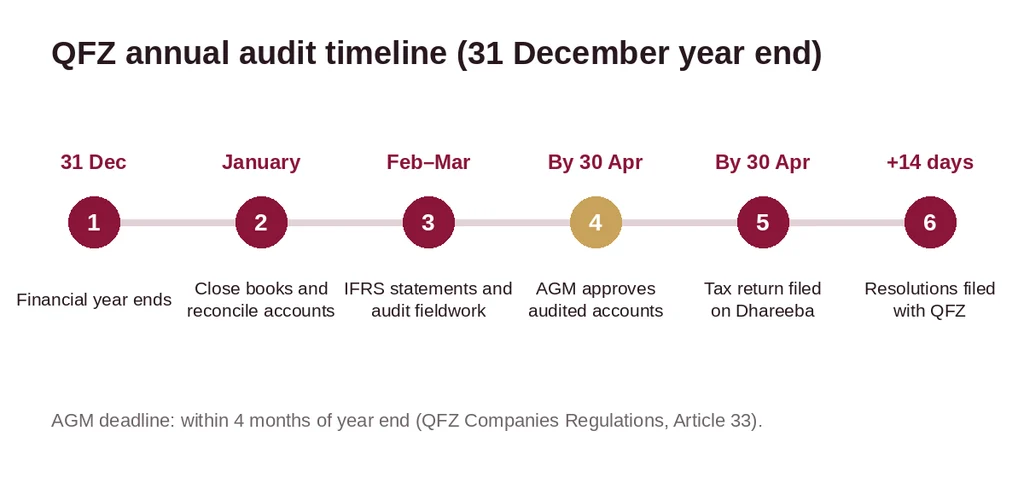
Timing is where many companies slip. The QFZ rules tie the audit to your Annual General Assembly Meeting (AGM), and the AGM has a firm deadline.
| Obligation | Deadline | Source |
| Hold the Annual General Assembly Meeting and approve audited accounts | Within 4 months of financial year end | QFZ Companies Regulations, Article 33 |
| File certified copies of relevant resolutions with the QFZ | Within 14 days of passing them | Article 41 |
| File the corporate income tax return with audited accounts on Dhareeba | Generally within 4 months of year end | Qatar Income Tax Law |
| Keep financial statements at the registered office | 10 years from preparation | QFZ Companies Regulations FAQ |
For a company with a 31 December year end, the practical deadline is therefore 30 April. Because the audit must finish before the AGM, you should aim to close your books by late January.
Always check the QFZ investor portal or your relationship manager for any current filing format. Requirements can change, so confirm them each year.
Both zones follow the same QFZ Companies Regulations. So the legal audit rules are identical. However, the type of business in each zone shapes what the auditor focuses on.
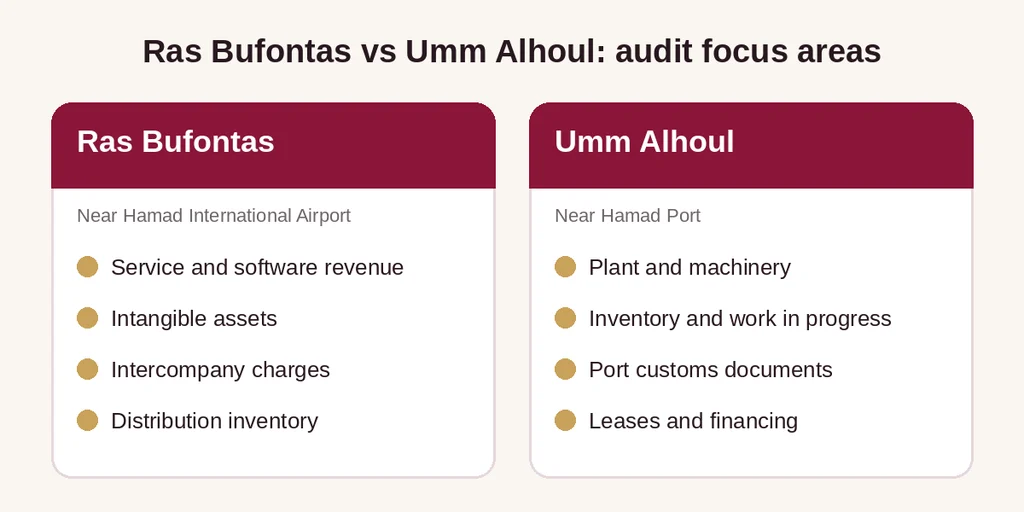
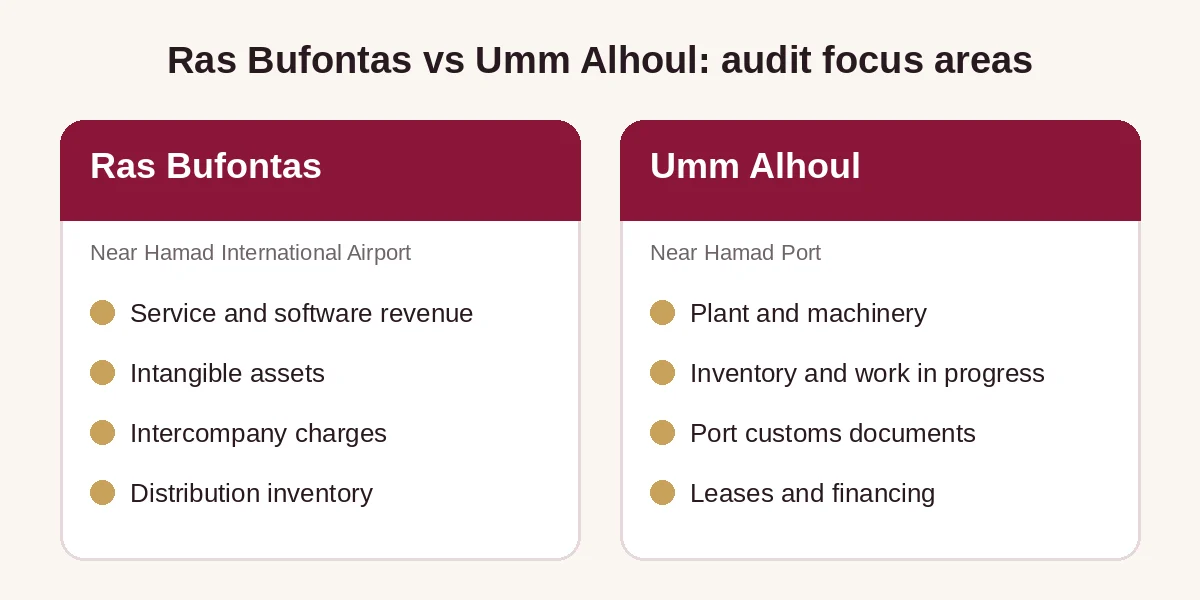
Ras Bufontas attracts technology, services, logistics and light manufacturing firms. For these businesses, a Ras Bufontas company audit often centres on:
Umm Alhoul hosts maritime, polymers, plastics and heavy manufacturing businesses. As a result, an Umm Alhoul free zone audit is usually more asset-heavy. Auditors tend to look closely at:
Whichever zone you are in, the same principle applies. The more complex your operations, the earlier you should start planning your audit.
Your auditor’s signature carries weight with the QFZ, the General Tax Authority, banks and investors. So choose carefully. Look for a firm that ticks these boxes:
Also remember the appointment rules. Shareholders appoint the auditor at the first General Assembly Meeting after incorporation, and the managers step in if they don’t. Reappoint or change your auditor formally at each AGM, and keep the resolution on file.
Ignoring the QFZ audit requirements can be costly. Under Article 62 of the Companies Regulations, the Authority may issue a Schedule of Sanctions for breaches. The exact amounts can change, so always check the current schedule with the QFZ.
Beyond formal sanctions, non-compliance can lead to:
In most cases, the cost of a timely audit is far lower than the cost of fixing a compliance problem later.
Many QFZ companies benefit from a corporate income tax holiday, which the QFZ promotes as up to 20 years and renewable. However, a tax holiday is not the same as having no tax duties.
In most cases, free zone companies must still register with the General Tax Authority (GTA). They also file an annual tax return through the Dhareeba portal, usually within four months of year end. The audited financial statements normally support that return and must be prepared in Qatari Riyals.
Large multinational groups need to take extra care. Qatar has introduced a global minimum tax under the OECD Pillar Two rules for groups with consolidated revenue of EUR 750 million or more. Free zone status does not automatically take you out of these rules.
The key takeaway is simple. Your audited accounts are the foundation for both QFZ compliance and tax compliance. Get one right and the other becomes much easier.
Use this checklist to get audit-ready before your auditor arrives:
Having these documents ready can cut audit time significantly. It also reduces the number of follow-up questions from your auditor.
Even well-run businesses fall into these traps:
Avoiding these mistakes keeps your audit smooth and your licence secure.
At Bookkeeping Qatar, we help free zone companies stay audit-ready all year round. Our team understands the QFZ Companies Regulations and the needs of businesses in both Ras Bufontas and Umm Alhoul.
Here’s how we support you:
We handle the numbers so you can focus on growing your business.
The QFZ audit requirements are clear once you break them down. Every free zone company must keep proper books, prepare IFRS financial statements and have them audited each year. The audited accounts go to shareholders at an AGM held within four months of year end. They also support your tax return with the GTA.
Whether you need a Ras Bufontas company audit or an Umm Alhoul free zone audit, early preparation is the secret to a smooth process. Start with good bookkeeping, choose a qualified auditor and track your deadlines.
Need help with your annual audit for free zone companies in Qatar? Contact Bookkeeping Qatar today for a free consultation.
Yes. The QFZ Companies Regulations require every company to keep proper books, prepare annual financial statements and appoint an auditor to audit them. This applies regardless of company size.
The audited accounts must be ready for the Annual General Assembly Meeting. This meeting must take place within four months of the financial year end. For a 31 December year end, that means by 30 April.
QFZ companies must prepare financial statements in line with international standards. In practice, this means IFRS. Most companies report in Qatari Riyals.
No. The audit duty comes from the QFZ Companies Regulations. In addition, most free zone companies still file a tax return on Dhareeba, supported by audited accounts.
The legal rules are the same in both zones. The difference lies in focus. Ras Bufontas audits often centre on services, technology and trading, while Umm Alhoul audits are usually more asset- and inventory-heavy.
Choose an auditor licensed to practise in Qatar with IFRS and free zone experience. Shareholders appoint the auditor at the first General Assembly Meeting, or the managers appoint one if they don’t.
Copies of financial statements must be kept at the company’s registered office for 10 years from the date they were prepared.
Yes. The Authority can request information, investigate a company’s affairs and appoint independent auditors to inspect its books and business.
The Authority may apply sanctions under its Schedule of Sanctions. Late audits can also delay licence renewals and lead to tax penalties from the GTA.
We maintain your books, prepare IFRS financial statements, coordinate with your auditor and track every deadline. As a result, your annual audit runs smoothly and on time.
Qatari business owners, entrepreneurs and managers — get in touch with Bookkeeping Qatar now for a free consultation.
Get free consultation!
Starting a business in Qatar is exciting. However, before you sign a lease or hire your first employee, you need two key approvals. The first is a commercial…

QFC company registration is one of the fastest ways for a foreign investor to set up a fully owned business in Qatar. It gives you a common-law legal…

For years, foreign investors in Qatar faced one big hurdle. They could own only 49% of a local company, and a Qatari partner had to hold the rest.…