

Bookkeeping vs Accounting: Key Differences for Qatar Businesses
Many business owners in Qatar use the words bookkeeping and accounting as if they mean the same thing. They are closely linked, but they are not the same…

Running a small business in Qatar moves fast. One week you’re signing a new client in West Bay, the next you’re chasing a supplier invoice in the Industrial Area, and somewhere in between the receipts pile up in a drawer. That’s exactly where reliable bookkeeping services in Qatar earn their keep. Clean books aren’t just a tidy habit. They decide whether your tax return goes in on time, whether your bank says yes to that credit line, and whether you actually know if last quarter made money.
Many founders in Doha start out doing the books themselves on a spreadsheet. It works until it doesn’t. Transactions grow, staff join, the General Tax Authority (GTA) asks for supporting records, and suddenly the spreadsheet has three versions and nobody trusts any of them.
This guide walks you through everything a small business owner needs to know: what bookkeeping covers, which rules apply in Qatar, how outsourcing compares with hiring in-house, what monthly bookkeeping services look like, what they typically cost, and how to pick a bookkeeping company in Qatar you can rely on for years.
Bookkeeping is the day-to-day recording of every riyal that comes in and goes out of your business. Accounting then uses those records to analyse, report and plan. Good bookkeeping is the foundation; without it, no accountant or auditor can produce figures you can trust.
A professional bookkeeping service in Qatar typically covers:
The best bookkeeping services in Doha go beyond data entry. They spot unusual expenses, point out slow-paying customers and give you numbers you can actually make decisions with.
Qatar’s tax system is simpler than many countries’, but it still expects proper records. Here are the main points every small business owner should understand.
Under Income Tax Law No. 24 of 2018, profits attributable to foreign ownership are taxed at a standard rate of 10%. Companies fully owned by Qatari or GCC nationals are generally exempt from the tax itself, but they still have to register and file a return through the GTA’s Dhareeba portal. Returns are normally due within four months of your financial year end, so a December year-end company files by the end of April.
Businesses must keep their books, invoices and supporting documents for at least ten years. The GTA can request these records during a review, and missing paperwork can lead to penalties or disallowed expenses.
Many companies, especially those with foreign shareholders or above certain capital and revenue levels, must submit financial statements audited by a Qatar-licensed auditor. An audit goes far more smoothly, and costs less, when the bookkeeping behind it is already clean.
Payments to non-resident service providers, such as royalties, technical fees, interest and commissions, may attract withholding tax that you must deduct and pay to the GTA. Excise tax also applies to specific goods like tobacco and sweetened or energy drinks.
Qatar has not introduced VAT yet, but it has signed the GCC VAT Framework, which sets a 5% standard rate. No launch date has been confirmed as of 2026 (Kintsugi). In May 2026 the Council of Ministers approved a draft e-invoicing law, widely seen as groundwork for VAT (Fiscal Requirements). Businesses with organised, digital books will find the switch to VAT far less painful than those still relying on paper.
Note: Companies registered in the Qatar Financial Centre (QFC) follow a separate tax regime. Always confirm the rules that apply to your specific licence.
Most small business owners didn’t start a company to reconcile bank statements. Yet the books affect almost every decision they make. Here’s why professional bookkeeping services pay for themselves.
You see your real cash position. Profit on paper and cash in the bank are two different things. Up-to-date books show what’s actually available to pay rent, salaries and suppliers this month, not what you hope will arrive.
You stay on the right side of the GTA. Late filings and weak records invite penalties. A bookkeeper keeps deadlines on the calendar and documents in order, so tax season stops being a scramble.
Banks and investors take you seriously. Whether you’re applying for a Qatar Development Bank programme, a commercial loan or pitching to an investor, the first request is usually for financial statements. Clean, consistent books make that conversation much easier.
You get your time back. Every hour spent matching receipts is an hour not spent on sales, customers or your team. For a founder, that trade-off is rarely worth it.
Mistakes get caught early. Duplicate payments, missed invoices and miscoded expenses are easy to fix in the month they happen. Left for a year, they become an expensive clean-up job right before your audit.
Once you decide the books need proper attention, the next question is who does the work. Hiring a full-time accountant in Qatar means a salary plus housing or allowances, a visa, medical insurance, end-of-service gratuity, software licences and annual leave cover. For a business with a few hundred transactions a month, that’s often more capacity than you need.
Outsourced bookkeeping in Qatar gives you a trained team for a fixed monthly fee. Here’s how the two compare:
| Factor | In-house accountant | Outsourced bookkeeping |
| Cost | Salary, visa, housing, insurance, gratuity | One predictable monthly fee |
| Expertise | One person’s experience | A team with tax, audit and payroll knowledge |
| Continuity | Work stops during leave or resignation | Service continues regardless of staff changes |
| Scalability | Hiring needed as you grow | Package adjusts to transaction volume |
| Technology | You buy and maintain software | Provider typically brings cloud tools |
| Oversight | Direct daily control | Regular reports and a dedicated contact |
In-house makes sense once you have high transaction volumes, complex inventory or need someone on site every day. For most startups, SMEs and branches of foreign companies, outsourcing is the more practical and cost-effective choice. Many growing firms also use a hybrid: an in-house admin handles receipts and invoices, while an outsourced team does reconciliations, reporting and compliance.
Monthly bookkeeping services are the most popular option for small businesses in Qatar because they keep records current without the overhead of a full-time hire. A typical monthly cycle looks like this:
At year end, these twelve months of tidy records feed straight into your audit and tax return. Some businesses with very low volumes choose quarterly bookkeeping instead, but monthly reporting gives you a much clearer view of cash flow and catches problems sooner.
Not every provider is the right fit for your business. Before you sign, ask these questions.
Do they know Qatar’s rules? Your bookkeeper should understand GTA requirements, the Dhareeba portal, withholding tax, WPS payroll and the difference between mainland and QFC entities. Ask how they’re preparing clients for VAT and e-invoicing.
Have they worked in your industry? Contracting, trading, restaurants, consultancies and e-commerce all have their own quirks, from retention payments to inventory valuation. Relevant experience saves time and avoids errors.
What software do they use? Cloud platforms such as Zoho Books, QuickBooks Online, Xero or Tally let you see your numbers anytime. Make sure you own your data and can export it if you ever change providers.
How do they protect your information? Ask about access controls, confidentiality agreements and how documents are stored.
Is the pricing clear? A good bookkeeping company in Qatar will quote a fixed monthly fee based on your transaction volume and list exactly what’s included. Watch for hidden extras like year-end adjustments or report fees.
Will you have one point of contact? A named accountant who knows your business is worth far more than a generic support inbox.
Can they grow with you? Look for a firm that also offers accounting, audit support, tax filing and advisory, so you don’t need to switch providers as your business expands.
There’s no single price list for bookkeeping services in Doha, because every business is different. Most providers set a monthly fee based on a few key factors:
| Factor | How it affects the fee |
| Monthly transaction volume | More invoices, bills and bank lines mean more work |
| Number of bank accounts and currencies | Each account needs its own reconciliation |
| Payroll size | More employees means more entries and WPS checks |
| Inventory | Stock tracking and costing add complexity |
| Reporting needs | Management reports, budgets or board packs cost extra |
| State of existing books | Backlogs or messy records need a one-time clean-up |
The smartest way to compare is to look at total value, not just the headline fee. A slightly higher monthly charge that includes reconciliations, management reports and year-end support often works out cheaper than a bare-bones package that bills extra at audit time. When you weigh it against the full cost of an in-house hire in Qatar, outsourced monthly bookkeeping is usually a fraction of the price.
We see the same problems again and again when new clients come to us. Avoiding them will save you money and stress.
At Bookkeeping Qatar, we provide professional bookkeeping services in Qatar built around the needs of small and growing businesses. Our team understands local regulations, GTA filing requirements and the practical realities of running a company in Doha.
Here’s what working with us looks like:
Whether you’re a startup in Qatar Science & Technology Park, a trading company in Doha or the local branch of an international firm, our outsourced bookkeeping lets you focus on growth while we keep your finances accurate and compliant.
Good bookkeeping isn’t paperwork for its own sake. It’s how you know where your money goes, how you stay compliant with the GTA and how you prepare for changes like VAT and e-invoicing. For most small businesses, outsourced monthly bookkeeping offers the right balance of expertise, cost and peace of mind.
If you’re looking for reliable bookkeeping services in Qatar, Bookkeeping Qatar is ready to help. Get in touch with our team today for a free consultation and a clear, fixed-fee quote tailored to your business.
Yes. Companies must keep proper books of account and supporting documents, file annual tax returns with the GTA and, in many cases, submit audited financial statements. Records must generally be kept for at least ten years.
Not yet. Qatar has signed the GCC VAT Framework with a planned 5% rate, but no implementation date has been announced. A draft e-invoicing law approved in 2026 suggests preparations are underway, so it’s wise to get your books VAT-ready now.
Bookkeeping records and organises daily transactions. Accounting interprets those records, prepares financial statements, handles tax planning and supports decision-making. Most small businesses need both, and many providers offer them together.
Yes. Even when no tax is payable because the company is wholly owned by Qatari or GCC nationals, it must still register with the GTA and file an annual return through Dhareeba.
Fees depend on transaction volume, number of bank accounts, payroll size, inventory and reporting needs. Most firms offer a fixed monthly fee after reviewing your records, which is usually far lower than the full cost of an in-house accountant.
A reputable provider uses secure cloud software, role-based access and signed confidentiality agreements. Always ask about data security and make sure you retain ownership of your records.
Yes. Catch-up bookkeeping is a common service. The team gathers past bank statements and invoices, reconstructs the records and brings your books up to date before regular monthly work begins.
Zoho Books, QuickBooks Online, Xero and Tally are widely used in Qatar. The best choice depends on your industry, inventory needs and budget. Your bookkeeper can recommend and set up the right one.
Monthly is ideal. It keeps cash flow visible, spreads the workload and makes year-end audits and tax filing much faster.
Yes. Companies in Qatar Free Zones and the Qatar Financial Centre must keep proper records, though QFC entities follow their own tax and reporting rules. Check the requirements tied to your licence.
Qatari business owners, entrepreneurs and managers — get in touch with Bookkeeping Qatar now for a free consultation.
Get free consultation!
Many business owners in Qatar use the words bookkeeping and accounting as if they mean the same thing. They are closely linked, but they are not the same…
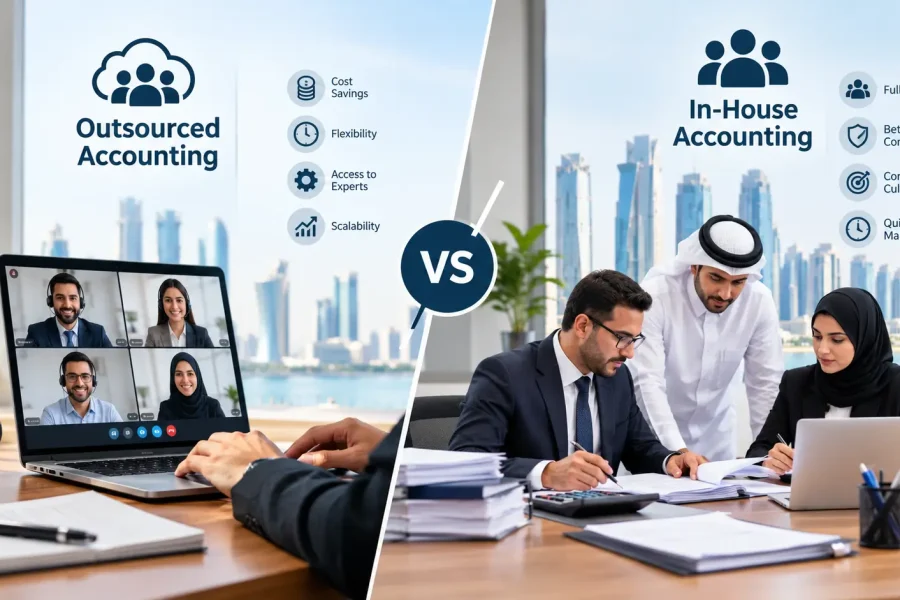
Every growing business in Qatar hits the same question sooner or later. Do you hire your own accountant, or do you hand the books to a specialist firm?…

Running a business in Qatar has a lot going for it. The market is stable, spending power is high, and the government keeps opening new doors for foreign…