

Bookkeeping vs Accounting: Key Differences for Qatar Businesses
Many business owners in Qatar use the words bookkeeping and accounting as if they mean the same thing. They are closely linked, but they are not the same…

Running a business in Qatar has a lot going for it. The market is stable, spending power is high, and the government keeps opening new doors for foreign investors. But there is one part of the job that catches many owners off guard: the numbers. Tax returns, audited statements, payroll files and a regulator that expects everything on time. That is where accounting services in Qatar come in.
This guide is written for founders, finance managers and SME owners who want a clear picture of how accounting works here. We will cover what the services include, which rules you actually have to follow, when outsourcing makes sense, and how to tell a good accounting company in Qatar from an average one. No jargon for the sake of it. Just what you need to make good decisions.
If you only have five minutes, jump to the section on choosing a provider and the FAQs at the end. If you have fifteen, read it top to bottom. It will save you a few headaches later.
At the simplest level, accounting services in Qatar are everything a firm does to record, organise, report and protect your financial information. That sounds broad because it is. A two-person trading company and a 300-employee contractor both need accounting, but they need very different things.
Most providers group their work into a few layers:
Think of bookkeeping as the foundation and advisory as the top floor. You can’t get reliable advice from a shaky ledger, which is why good accounting and bookkeeping services always start with clean records.
A lot of small business owners start out doing their own books in Excel. That works for a few months. Then the invoices pile up, the bank reconciliation stops matching, and tax season arrives with a stack of unanswered questions.
Here is why most companies eventually bring in professional accountants in Doha or elsewhere in the country:
Qatar has tightened its tax administration a lot over the past few years. Filing is digital, deadlines are fixed and penalties are real. Late or incorrect returns can lead to fines that cost far more than a year of accounting fees.
Try applying for a credit facility with a shoebox of receipts. Banks in Qatar want audited financial statements and clean management accounts. So do investors, landlords on large leases and government tender committees.
When your books are current, you can see which product lines make money, which clients pay late and where cash is leaking. Without that visibility, you are running the business on gut feeling.
Every hour a founder spends chasing receipts is an hour not spent on sales, hiring or strategy. Handing the books to a specialist is often the cheapest productivity gain available.
Before you hire anyone, it helps to know the rules your accountant will be working with. Qatar’s system is simpler than many countries, but it has some quirks that trip up newcomers.
Most companies fall under the General Tax Authority (GTA), which handles corporate tax, withholding tax and excise tax through its online portal, Dhareeba. Companies licensed by the Qatar Financial Centre (QFC) sit under a separate tax regime with its own filing rules. The Commercial Companies Law also requires most companies to keep proper books and have their annual accounts audited.
| Tax | Rate | Who it affects |
| Corporate income tax | 10% | Foreign-owned share of profits earned in Qatar |
| Withholding tax | 5% or 7% | Certain payments to non-residents (royalties, technical fees, interest, commissions, services) |
| Global minimum tax (Pillar Two) | 15% effective | Multinational groups with revenue of EUR 750 million or more |
| Excise tax | 50% to 100% | Tobacco, energy drinks, sweetened drinks and similar goods |
| VAT | Not in force yet | Expected at 5% under the GCC framework |
| Personal income tax | None | Salaries are tax-free |
A quick note on ownership. Companies fully owned by Qatari or GCC nationals are generally exempt from corporate tax on that share. But exempt does not mean invisible. Many still have to register, file returns and submit audited financial statements through Dhareeba.
The corporate tax return is normally due within four months of your financial year-end, so 30 April for calendar-year companies. QFC entities generally have six months. The GTA does extend deadlines from time to time; for example, it pushed the 2025 deadline to 30 June 2026. Don’t plan around extensions, though. Plan around the standard date.
Three developments matter for 2026 and beyond:
If your accounting system can’t produce clean, structured invoice data today, now is a good time to fix that.
Sources: GMPA on Qatar e-invoicing, VATCalc on Qatar VAT, Qatar Living on corporate tax 2026, MBG on corporate tax structuring. Check the GTA website before publishing for any newer announcements.
Every firm packages its services a little differently, but these are the building blocks you will see on almost any proposal.
This is the daily or weekly work of recording every transaction. Sales invoices, supplier bills, petty cash, card payments, loan repayments. A good bookkeeper also codes each item to the right account, so your reports actually mean something.
Your books should match your bank statements to the riyal. Monthly reconciliation catches missing entries, duplicate payments and, occasionally, fraud. It is boring work, and it is the work most often skipped by busy owners.
On the payable side, this means tracking what you owe and paying on time without paying twice. On the receivable side, it means invoicing promptly and chasing overdue clients. In a market where 60 to 90-day payment terms are common, tight receivables control can make or break your cash flow.
Qatar’s Wage Protection System (WPS) requires salaries to be paid through approved banks in a set format. Your accountant can prepare the salary file, track end-of-service gratuity and keep payroll records audit-ready.
Monthly profit and loss, balance sheet and cash flow reports, ideally with a short commentary. These are for you, not the regulator, and they are where the real value of accounting shows up.
Preparing and filing corporate income tax returns, monthly withholding tax returns, and any excise filings. It also covers responding to GTA queries and keeping documentation in case of a review.
Many Qatar businesses are moving from desktop software or spreadsheets to cloud platforms like Zoho Books, Xero, QuickBooks Online or Odoo. A good provider will set up your chart of accounts properly from day one, which saves a lot of cleanup later.
Bookkeeping keeps the records. Financial accounting turns them into statements that outsiders can trust. In Qatar, that means statements prepared under International Financial Reporting Standards (IFRS).
Financial accounting services in Qatar usually include:
Here is something many owners only learn the hard way. Your accountant and your auditor are not the same person, and they shouldn’t be. The auditor checks the work. If the work is messy, the audit drags on, fees go up and you risk missing the tax deadline.
A well-prepared audit file can cut weeks off the process. It also means fewer awkward questions and fewer qualified opinions, which matter when banks or investors read your accounts.
If your company trades with related parties, such as a parent company abroad, you may also need transfer pricing disclosures and, for larger groups, a master file and local file. Your financial accountant should flag this early rather than at filing time.
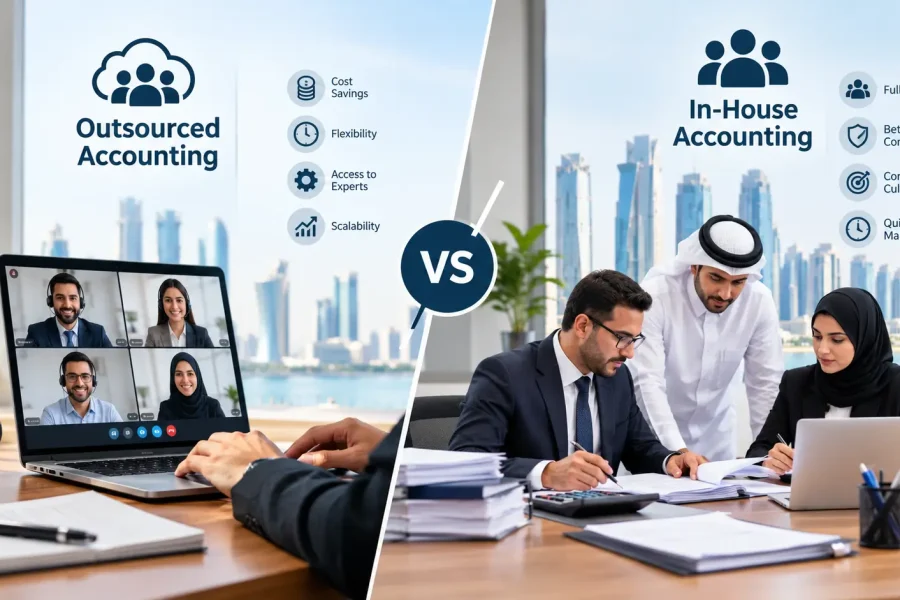
This is the question almost every growing company asks at some point. Should you hire your own accountant, or hand the work to a firm?
Honestly, there is no single right answer. But for most SMEs, outsourced accounting in Qatar wins on cost and coverage. Here is how the two options compare.
| Factor | In-house accountant | Outsourced accounting firm |
| Cost | Salary, visa, housing, insurance, gratuity, training | Fixed monthly fee, scaled to your volume |
| Expertise | One person’s skill set | A team covering bookkeeping, IFRS, tax and payroll |
| Continuity | Work stops during leave or resignation | Cover is built in |
| Tax updates | Depends on the individual keeping up | Firm tracks GTA changes as part of the job |
| Control | Sits in your office, easy to reach | Remote, but usually with a named account manager |
| Best for | Larger firms with heavy daily volume | Startups, SMEs and foreign branches |
If you process hundreds of transactions a day, run a complex inventory or need someone physically present for approvals, an in-house team is worth it. Even then, many companies keep an outside firm for tax filing and year-end work.
A popular middle path is to keep one in-house finance officer for daily entries and outsource the specialist work: monthly reviews, IFRS statements, tax returns and audit support. You get control and expertise without paying for a full department.
There is no shortage of firms offering accounting services in Doha. The hard part is telling them apart. Use these questions as a filter before you sign anything.
Not every company needs the same package. Here is what typically matters most for the business types we see in Qatar.
Keep it lean. Clean bookkeeping, monthly reconciliations and help with the first tax registration. Get the chart of accounts right early, because fixing a year of miscoded entries is expensive.
These carry the heaviest tax load. Expect corporate tax on the foreign share of profits, withholding tax on payments to overseas parties and possibly transfer pricing work. Parent companies also often want reports in their own group format.
QFC firms follow a separate tax regime and have their own reporting rules. Make sure your provider has real QFC experience, not just mainland experience.
Project accounting is the big one here. Revenue recognition under IFRS 15, retention tracking and job costing all need careful handling. Subcontractor payments to non-residents may also trigger withholding tax.
High transaction volume and inventory are the main challenges. Point-of-sale integration, stock counts and margin tracking matter more than anything else. Businesses selling sweetened drinks or tobacco also need to watch excise tax.
Time and billing, project profitability and receivables control. Cash flow can swing a lot when large clients pay late, so forecasting is especially useful.
We see the same problems again and again. Most are easy to avoid once you know about them.
At Bookkeeping Qatar, we built our services around one simple idea: business owners should understand their numbers without having to become accountants.
Here is what working with us looks like:
Our team of professional accountants in Doha works with startups, SMEs, foreign branches and QFC firms. Whether you need a full finance function or just help getting your year-end in order, we will shape the service around what you actually need.
Ready to get your books in order? Book a free consultation with Bookkeeping Qatar and we will review your current setup at no cost.
Good accounting rarely gets noticed when it works. You only notice it when it fails: a missed deadline, a rejected loan application, a penalty letter from the GTA. The goal is to never get there.
Qatar’s rules are clear, but they are changing. Pillar Two is already live, e-invoicing has been approved, and VAT is on the horizon. Companies that treat accounting as a strategic function, not an afterthought, will handle these changes calmly. Everyone else will be scrambling.
Whether you hire in-house, outsource fully or go hybrid, the right accounting services in Qatar should give you three things: compliance, clarity and time back to run your business. If your current setup isn’t giving you all three, it may be time for a change.
No. As of October 2026, VAT has not been introduced in Qatar. It is expected at a 5% rate under the GCC framework, and the e-invoicing law approved in May 2026 is widely seen as a step toward it. No official start date has been announced.
The standard rate is 10% on taxable profits earned in Qatar, applied to the foreign-owned share of a business. Large multinational groups with revenue of EUR 750 million or more are subject to a 15% minimum effective rate under Pillar Two.
The Cabinet approved the draft e-invoicing law in May 2026, but a go-live date has not been published yet. Businesses should start checking whether their accounting software can produce structured electronic invoices.
Often, yes. Even when profits are exempt from corporate tax, many Qatari-owned companies must still register on Dhareeba and submit returns and audited financial statements, depending on their size and structure.
Most companies registered under the Commercial Companies Law must have their annual financial statements audited by a licensed auditor. Audited statements are also usually required with the corporate tax return.
It depends on transaction volume, the number of employees and the services you need. Small businesses often pay a fixed monthly fee for bookkeeping, with tax filing and year-end statements priced separately or bundled. Always ask for a written scope before comparing quotes.
It can be, if you choose the right provider. Look for firms that use secure cloud software, sign confidentiality agreements, limit access by role and follow Qatar’s personal data protection law.
Dhareeba is the GTA’s online tax system. Businesses use it to register, file corporate and withholding tax returns, pay taxes and, since August 2026, register for Pillar Two.
Withholding tax applies when a Qatar business pays certain fees to non-residents, such as royalties, technical fees, interest, commissions or services performed in Qatar. The rate is 5% or 7%, and the payer must deduct it and file a monthly return.
Cloud tools like Zoho Books, Xero, QuickBooks Online and Odoo are popular with SMEs. Larger companies often use SAP or Microsoft Dynamics. With e-invoicing coming, pick a system that can support structured digital invoices.
Yes. Many foreign branches and newly registered companies use outsourced accounting in Qatar so local compliance is handled from day one, even before they hire staff on the ground.
Start with clean books, a proper chart of accounts and software that can handle tax codes and e-invoices. Review your contracts and pricing, and train your team. An accounting partner can run a readiness review so you are not caught off guard.
Qatari business owners, entrepreneurs and managers — get in touch with Bookkeeping Qatar now for a free consultation.
Get free consultation!
Many business owners in Qatar use the words bookkeeping and accounting as if they mean the same thing. They are closely linked, but they are not the same…

Running a small business in Qatar moves fast. One week you’re signing a new client in West Bay, the next you’re chasing a supplier invoice in the Industrial…
Every growing business in Qatar hits the same question sooner or later. Do you hire your own accountant, or do you hand the books to a specialist firm?…