
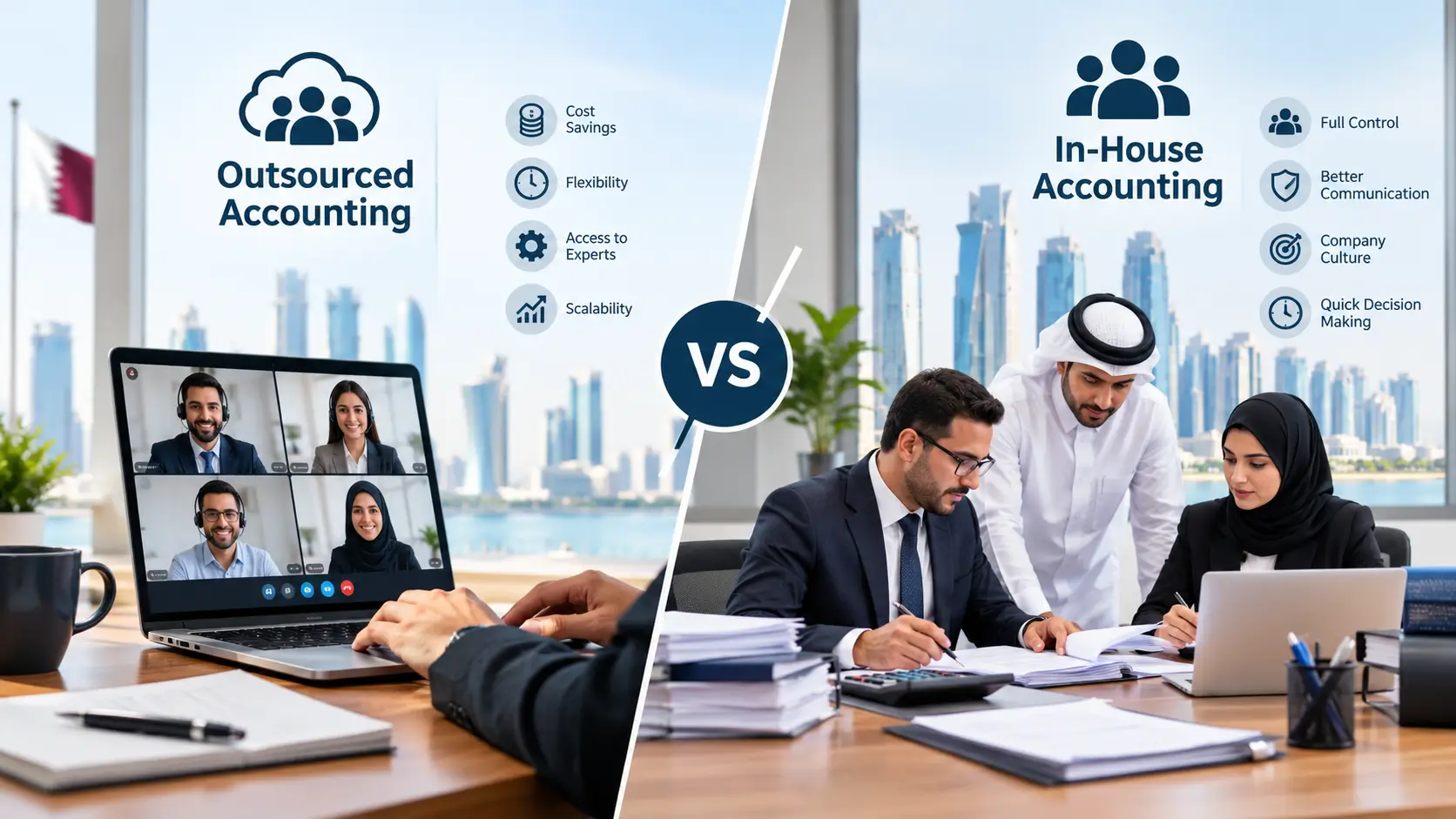
Every growing business in Qatar hits the same question sooner or later. Do you hire your own accountant, or do you hand the books to a specialist firm? On paper, both work. In practice, the right choice depends on your size, your budget and how much compliance risk you are willing to carry.
Over the last few years, more companies in Doha, Lusail and Al Wakrah have started using outsourced accounting services in Qatar instead of building a full finance department. Part of that is cost. Part of it is the tighter tax and reporting rules that the General Tax Authority now enforces through the Dhareeba portal.
This guide breaks down the in-house vs outsourced accounting debate in plain terms. We will look at real costs, control, expertise and risk, so you can decide what actually fits your business rather than what sounds good in a sales pitch.
What In-House Accounting Really Means in Qatar
In-house accounting means you employ your own accountant, or a small team, who sits in your office and works only for you. They handle daily entries, payroll through the Wage Protection System (WPS), supplier payments, bank reconciliations and monthly reports.
The biggest advantage is closeness. Your accountant knows your staff, your clients and your quirks. If the CEO needs a cash position at 4 pm, someone can walk over and pull it up.
But hiring in Qatar comes with more than a salary. You are also paying for a residence permit, medical cover, annual air tickets, end-of-service gratuity of at least three weeks’ basic pay for each year worked, and often housing and transport allowances. Add accounting software licences, a laptop and desk space, and one accountant becomes a much larger line item than the offer letter suggests.
There is also a single-point-of-failure risk. When your one accountant goes on annual leave, resigns or falls sick during closing season, the work simply stops.
How Outsourced Accounting Services in Qatar Work
When you outsource accounting in Qatar, an external firm takes over some or all of your finance work under a monthly agreement. You share invoices, receipts and bank statements, usually through a secure cloud system, and the firm returns clean books, reports and filings on an agreed schedule.
Most providers offer accounting and bookkeeping services in flexible packages. A typical scope covers:
- Daily bookkeeping and ledger maintenance
- Accounts payable and receivable tracking
- Payroll processing and WPS file preparation
- Monthly and quarterly management reports
- Year-end financial statements ready for the external auditor
- Corporate income tax return support and Dhareeba filings
- Virtual CFO support for budgets, cash flow and forecasting
You are not buying one person’s time. You are buying access to a team that has seen hundreds of businesses, knows the local rules and has a reviewer checking the work before it reaches you.
Accounting Costs in Qatar: A Side-by-Side Look
Cost is usually where the conversation starts, so let’s be honest about it. The figures below are indicative ranges for a small to mid-sized company and will vary with experience, industry and transaction volume.
| Cost item | In-house accountant (per year) | Outsourced service (per year) |
| Salary or service fee | QAR 96,000 – 180,000 | QAR 18,000 – 72,000 |
| Visa, medical and air tickets | QAR 8,000 – 15,000 | Included |
| End-of-service gratuity | Builds up every year | None |
| Software and IT | QAR 3,000 – 10,000 | Usually included |
| Training and CPD | Your responsibility | Provider’s responsibility |
| Cover during leave | Extra cost or delays | Team covers it |
For most SMEs, the gap is hard to ignore. A full-time hire often costs two to four times more than a well-scoped outsourcing package. Accounting costs in Qatar only start to favour in-house teams once transaction volumes are high enough to keep several people busy every day.
Figures are approximate market ranges, not quotes. Always compare a written proposal against your own payroll numbers.
In-House vs Outsourced Accounting: Beyond the Price Tag
Compliance and Tax Risk
Qatar’s Income Tax Law No. 24 of 2018 requires businesses to keep proper books and supporting records for ten years. Companies with foreign ownership pay 10% corporate income tax on their share of profits, and many entities must submit audited financial statements with their annual return. Late or incorrect filings bring penalties that can easily outweigh a year of accounting fees.
A single in-house accountant may be excellent at daily work but miss a regulatory update. An outsourcing firm tracks these changes across its whole client base, so updates reach you as part of the service.
Expertise and Quality Control
With one employee, you get one person’s knowledge. With a firm, you get bookkeepers, senior accountants and tax specialists, plus a review step before anything is filed. That second pair of eyes is one of the most underrated accounting outsourcing benefits.
Control and Access
This is where in-house teams still win. Having someone on-site means faster answers and deeper knowledge of your operations. That said, good providers now give you live cloud dashboards and a named account manager, which closes much of that gap.
Scalability
Opening a new branch or winning a big contract? An outsourced team scales up within weeks. Hiring in-house means recruitment, visa processing and onboarding, which can take months.
Which Option Fits Your Business?
Outsourcing usually makes sense if you:
- Are a startup, SME or newly registered QFC or MOCI company
- Process a manageable number of transactions each month
- Want predictable monthly costs with no gratuity build-up
- Need tax and audit support without hiring a specialist
- Have struggled with staff turnover in your finance role
In-house usually makes sense if you:
- Run a large operation with heavy daily transaction volumes
- Need someone physically present for cash handling or site visits
- Work in a highly specialised sector with custom internal processes
The Hybrid Route
Many Qatar businesses land somewhere in between. They keep a junior accountant on-site for daily entries and outsource the review, payroll, tax filings and year-end close. This mix often gives the best balance of control and expertise without the cost of a full finance department.
Why Businesses Choose Bookkeeping Qatar
At Bookkeeping Qatar, we work with startups, trading companies, contractors and service firms across the country. Our accounting services in Qatar are built around what local businesses actually need, not a one-size package copied from somewhere else.
Here is what you get when you work with us:
- A dedicated accountant who knows your business by name
- Cloud-based books you can check anytime
- Monthly reports delivered on fixed dates
- Payroll, WPS and corporate tax support under one roof
- Audit-ready financial statements at year-end
- Clear, fixed monthly pricing with no surprise charges
Whether you need full accounting and bookkeeping services or just someone to review your in-house team’s work, we shape the scope around you.
Final Verdict: Which Is Better?
There is no single winner for every company. But for most small and mid-sized businesses, outsourced accounting services in Qatar deliver better value, stronger compliance and less day-to-day stress than a full in-house setup. In-house teams make sense once you reach a size where the workload justifies them, and even then, outsourcing the specialist parts often pays off.
The smart move is to compare the true cost of each option, not just the salary figure. If you want a clear breakdown for your own business, talk to the Bookkeeping Qatar team today for a free consultation and a fixed-fee proposal.
Frequently Asked Questions
1. How much do outsourced accounting services in Qatar cost?
Most small businesses pay a fixed monthly fee based on transaction volume and scope. Packages commonly start from around QAR 1,500 per month for basic bookkeeping and rise with payroll, tax and reporting needs.
2. Is it legal to outsource accounting in Qatar?
Yes. Qatari law requires you to keep proper books and records, but it does not require an in-house accountant. You remain responsible for your filings, so choose a provider you trust.
3. Will I lose control of my financial data if I outsource?
Not with a good provider. You should get cloud access to your books, regular reports and a named contact who answers your questions quickly.
4. Can an outsourced accountant handle corporate tax filing on Dhareeba?
Yes. Most firms prepare your tax return, support the audit process and help you submit through the General Tax Authority’s Dhareeba portal.
5. Is outsourcing suitable for startups in Qatar?
It is often the best fit. Startups get professional books from day one without the cost of a full-time hire, visa and gratuity.
6. Does Qatar have VAT, and will my accountant handle it?
Qatar has not yet introduced VAT, although it has been discussed for years. A good accounting partner will keep your systems ready so the switch is smooth if it arrives.
7. What is the difference between bookkeeping and accounting?
Bookkeeping records daily transactions. Accounting uses those records to prepare reports, financial statements and tax returns. Most firms offer both together.
8. How do I switch from in-house to outsourced accounting?
Start with a handover of your current ledgers, bank statements and payroll records. A reliable provider will review past entries, fix gaps and set up a monthly routine within a few weeks.
